A complete guide covering job duties, skills assessment, visa options, salary, and how to migrate to Australia as an ICT Project Manager. This guide covers everything about ANZSCO 135112. That will cover what the job is, what it involves, what skills you require, how it is assessed, what visas exist and what sort of salary you can earn.
Home > ICT Project Manager ANZSCO 135112
Project Planning
Team Leadership
Budget Control
Risk Management
If you work in IT project management and you are thinking about moving to Australia, you have probably come across the code 135112. This is the ANZSCO code for ICT Project Manager. It is classed under the umbrella term of ICT Managers, and is also one of the more well-known technology professions within the Australian immigration system.
You might be only beginning to think about what to do, or you might be actually assembling your application, but this page has the information you require.
What is an ANZSCO 135112 ICT Project Manager?
According to the official ANZSCO classification, ANZSCO stands for Australian and New Zealand Standard Classification of Occupations. Every skilled job in the immigration system has a code. The code for the ICT Project Manager is 135112.
An ICT Project Manager plans, organises, directs, and controls ICT-related projects. They are responsible for making sure a project stays on schedule, within budget, and meets the set objectives. In day-to-day, this position entails aspects such as resource allocation, scheduling, prioritisation and coordination with various teams.
One specialisation that falls under this code is ICT Development Manager. In case your job fits such a description, you can still fall under 135112.
It is not only a position involving ensuring the timely running of things. It is more than just that. Here are the core tasks that fall under ANZSCO 135112:
Practically, this position needs you to have knowledge of the software development life cycle (SDLC) and be familiar with project management approaches such as Agile, Scrum, or Waterfall. The use of JIRA, MS Project, and Confluence is common in this type of work.
You should also be a kind of individual who can be a leader of a team, decide quickly and be well organised even in cases where several processes are running simultaneously.
ANZSCO 135112 is classified as Skill Level 1. This is the highest skill level in the ANZSCO system. It generally means the job requires a bachelor’s degree or higher.
That being said, the only thing is formal credentials. If you have at least five years of relevant experience in ICT project management, that experience can be accepted in place of a degree. Your application can also be supported in certain cases by relevant vendor certifications.
Therefore, in case you majored in Information Technology, Computer Science, Software Engineering or a similar subject, then you are heading in the right direction. However, when your degree is not in the field of ICT directly, then what you did on the job and your work experience will be of high weight.
Whichever the case, you cannot get into this position as a new graduate. It is the nature of the job that you must have actual project leadership experience prior to being able to make this claim in an immigration context.
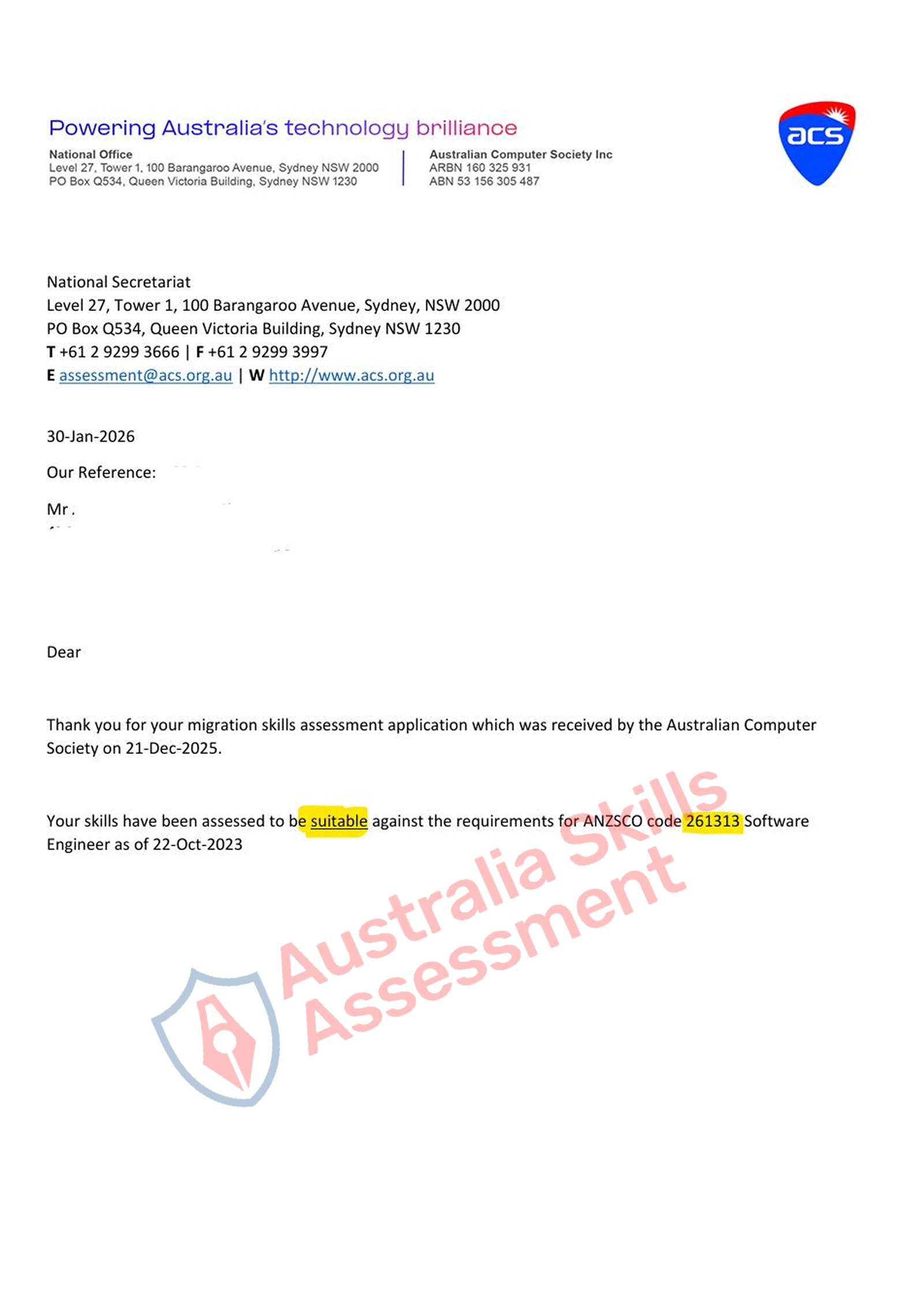
The programs of this occupation are assessed by the Australian Computer Society, which is popularly referred to as ACS. Before you apply for a skilled visa, you need ACS to assess your qualifications and work experience.
ACS looks at whether your education and your actual work experience match the requirements for this occupation. They verify such aspects as whether or not your degree is in a closely related area, whether your job responsibilities align with the description of ANZSCO and whether or not you have the required number of years of experience of a relevant type.
1. Qualification-Based Assessment
This is the mainstream path in case you have a degree in an ICT-related area. ACS reviews your academic transcripts, employment history, and the job duties you performed.
2. ACS RPL (Recognition of Prior Learning)
This pathway is for people who do not have an ICT-related degree. Through RPL, you can show your skills through detailed project reports that describe the ICT work you have done.
Your RPL report needs to clearly describe specific projects you managed. It should include the scope of all the projects. Along with your personal contribution, the way you handled budgets and deadlines, the tools you used, and the choices you made. The vague descriptions do not work in this instance. ACS wants to see real examples of your leadership in an ICT context.
You must have a positive ACS assessment before you can place an Expression of Interest in SkillSelect for most skilled migration visas.
When you have a good ACS assessment, you have a number of visa routes. The right one is contingent upon your own circumstances, your points, and a job offer or a state nomination.
Skilled Independent Visa (Subclass 189)
This is a points-tested permanent residency visa. You do not need an employer or state to sponsor you. You provide an Expression of Interest via SkillSelect and await an invitation. You are given an opportunity based on the number of points as compared to other candidates in the same profession.
Skilled Nominated Visa (Subclass 190)
This is also a permanent residency visa, but it requires nomination from an Australian state or territory government. The ICT Project Manager appears on the Short-Term Skilled Occupation List (STSOL), which means state nomination is needed for the 189 pathway to work for most applicants. A 190 nomination adds 5 points to your score.
Skilled Work Regional Visa (Subclass 491)
This is a temporary visa for regional Australia. It is sponsored by a state or territory, or by an eligible family member. It carries an extra 15 points. After living and working in a regional area for the required time, you can apply for the Subclass 191 permanent visa.
Skills in Demand Visa (Subclass 482)
This is an employer-sponsored temporary visa. Your employer needs to be an approved sponsor. Under the Core Skills stream, an ICT Project Manager is an eligible occupation. This visa can also be a pathway to permanent residency through the Employer Nomination Scheme.
Employer Nomination Scheme (Subclass 186)
It is a permanent visa that is sponsored by the employer. You need an Australian employer to nominate you for this occupation. It requires you to have the necessary skills and at least two years of work experience in the role.
ICT Project Managers are paid well in Australia. The precise figure will depend on experience, location, industry and company size, but the figures are usually good.
On average, an ICT Project Manager in Australia earns somewhere around $145,000 per year for male employees and around $131,000 for female employees. The average salary of entry-level professionals in this area is around $100,000 to $130,000 annually. Older professionals or individuals in big companies can make much more money.
The cities of Sydney, Melbourne, and Canberra are generally more likely to have higher salaries because the largest tech firms and government contracts are concentrated in these cities. The regional ones can provide a little less in base pay; however, they also can provide state nomination benefits that can be of real value to your migration experience.
In order to immigrate, you must also satisfy the Temporary Skilled Migration Income Threshold (TSMIT) when applying via employer-sponsored pathways.
Australia has been investing heavily in digital transformation across both the public and private sectors. Large IT projects are being conducted by government agencies, hospitals, banks, logistics companies and universities. They all need people who can manage these projects from start to finish.
Skilled ICT project managers are in constant demand; they are really difficult to come by. It requires both technical knowledge and good management skills, and that cannot be easy to find.
One reason why the occupation is still on the skilled occupation lists utilised in the migration system is this demand.
Here are a few things worth knowing before you go ahead with your application:
Category | Details |
ANZSCO Code | 135112 |
Occupation Title | ICT Project Manager |
Specialisation | ICT Development Manager |
Skill Level | Level 1 (Highest) |
Assessing Authority | Australian Computer Society (ACS) |
Qualification Required | Bachelor’s degree in ICT or related field, or 5+ years of experience |
Average Salary | Around $130,000 to $145,000 per year |
Visa Options | 189, 190, 491, 482 (Core Skills), 186 |
Occupation List | Short-Term Skilled Occupation List (STSOL) |
ANZSCO 135112 can provide you with a good direction in case you have experience in managing ICT projects. You are planning to go to Australia. The occupation is recognised, well-paid, and has multiple visa options available.
The trick is to ensure that your work history is what ACS wants in this code. When that is sorted, you can proceed with your EOI, state nomination or employer sponsorship, whichever suits your circumstances.
Allow yourself time to do the assessment process. An excellent application really counts in the outcome.
Email: info@australiaskillsassessment.com
Call/WhatsApp: +61 483 984 780
Website: australiaskillsassessment.com
Contact Us
Our Services
100% Secure
SSL Encrypted
4.9/5 Rated
We accept:
VISA
Mastercard
Stripe
Wise
PayPal
Disclaimer:
Copyright © 2020 – 2026 AustraliaSkillsAssessment
100% Secure Payments | Trusted in 70+ Countries | 4.9/5 Rated | 99% Success