
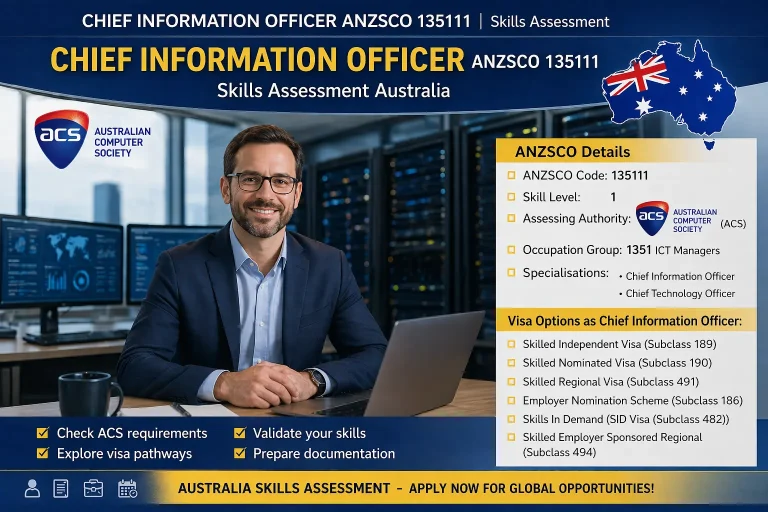
In case you are in the tech industry and you are considering moving to Australia, the Chief Information Officer position could be just the thing you should explore. This job has its own ANZSCO code: 135111. The Australian government has labelled this occupation as such under skilled Migration purposes.
Home > Chief Information Officer ANZSCO 135111
IT Strategy
Digital Leadership
System Governance
Technology Planning
A Chief Information Officer or CIO is merely the most senior person who oversees all the technology systems in a company. Their main job is to plan, organise, direct, and control all ICT (Information and Communication Technology) operations. The aim is to ensure that the tech setup of the company is in line to facilitate its daily operations.
Sometimes this role is also called a Chief Technology Officer (CTO). That is the only alternative title listed under ANZSCO 135111.
Consider it in the following way: a company is a car; the CIO is someone who ensures that the engine (the tech) keeps operating so that the car can get where it has to go.
Here are the key tasks a CIO is expected to handle on the job:
Task | What It Means |
Analyse information needs | Figure out what data and tech the company needs |
Set ICT strategies | Make plans for how tech will be used across the whole company |
Direct ICT resources | Choose and install the right tools and software |
Set priorities | Decide which tech projects get done first |
Oversee system security | Make sure the company’s digital systems are safe |
It is not simply about knowing computers. A CIO also has to be a good leader who understands business goals.
This occupation lies on Skill Level 1 of the ANZSCO system. This is the maximum level of skill of the system. It usually means you need a bachelor’s degree or higher to do the job.
Category | Details |
Major Group | 1 – Managers |
Sub-Major Group | 13 – Specialist Managers |
Minor Group | 135 – ICT Managers |
Unit Group | 1351 – ICT Managers |
ANZSCO Code | 135111 |
Skill Level | 1 (Highest) |
Other jobs in the same unit group include:
Before you can apply for a skilled visa using this occupation, you need a skills assessment. For ANZSCO 135111, the assessing body is the Australian Computer Society (ACS).
The ACS has four pathways depending on your background:
For people who have finished an Australian bachelor’s degree or higher. This is only for the subclass 485 visa. No work experience needed, but your degree must be ICT-focused.
For Australian graduates who want a general skills assessment. You need an ICT bachelor’s degree plus either one year of work experience after graduation, OR you must have completed an ACS Professional Year Program.
This is for people who studied overseas or have a mix of qualifications and experience. The options here are:
For people who do not have a proper ICT qualification. You will need:
Looking to migrate as an Industrial Engineer? Get expert guidance for the Industrial Engineer ANZSCO 233511 skills assessment, documentation, and visa pathways for Australia.
This occupation opens up several visa pathways. The following is a brief description:
Visa | Type | Available? |
Subclass 189 (Skilled Independent) | Points-based PR | No |
Subclass 190 (Skilled Nominated) | State-nominated PR | No |
Subclass 485 (Graduate Temporary) | Temporary | Yes |
Subclass 491 (Skilled Regional) | Regional temporary | No |
Subclass 186 (Employer Nomination) | Permanent | Yes |
Subclass 407 (Training) | Short-stay training | Yes |
Subclass 494 (Regional Employer Sponsored) | Regional temporary | Yes |
Subclass 482 SID (Skills in Demand) | Employer sponsored | Yes |
This is a permanent visa. Your employer must sponsor you. Key requirements:
This is a temporary visa that lets you live and work in Australia for up to 4 years. It can lead to permanent residency through the 186 transition stream.
This one is for working in regional parts of Australia. You need:
Most visa applications for this occupation require at least Competent English. The following is how that would appear when tested in various tests:
Test | Minimum Score |
IELTS | Overall 6.0 (some visas need 7 in speaking) |
PTE Academic | 50 overall (65 in speaking for some) |
TOEFL iBT | Overall 93 (L:12, R:13, W:21, S:23) |
OET | Minimum Grade B in all sections |
Citizens of the UK, USA, Canada, New Zealand, and Ireland are usually exempt from English testing.
Based on the job data, CIOs in Australia make approximately $2,766 per week. That amounts to approximately $143,800 annually. Most people in this role work full-time, averaging about 49 hours per week. Around 97% of CIOs work full-time hours.
Metric | Data |
Weekly Earnings | $2,766 |
Approximate Annual Salary | $143,800 |
Average Full-time Hours | 49 hours/week |
Full-time Workers | 97% |
Female Workforce Share | 10% |
Job Growth (next 5 years) | Strong |
Only about 10% of people in this occupation are female, which shows there is still a big gender gap in tech leadership roles. Job growth for this occupation is expected to be strong over the next five years.
If you are planning this career path from scratch, you will most likely need a Bachelor of Information Technology or Bachelor of Computer Science. An average bachelor of IT 3-year course is approximately 3 years and costs approximately 99,100 AUD in total tuition.
The entry requirements typically include:
Similar learning opportunities are available as a Bachelor of Computer Science, Bachelor of Information Technology and Business and Master of Information Technology.
Based on the 2025 Occupation Shortage List, ANZSCO 135111 is currently listed as No Shortage (NS) across all states and territories in Australia. This suggests that there is no urgent demand for CIOs in the labour market at present.
State/Territory | Shortage Status |
National (Australia) | No Shortage |
New South Wales (NSW) | No Shortage |
Victoria (VIC) | No Shortage |
Queensland (QLD) | No Shortage |
South Australia (SA) | No Shortage |
Western Australia (WA) | No Shortage |
Tasmania (TAS) | No Shortage |
Australian Capital Territory (ACT) | No Shortage |
Northern Territory (NT) | No Shortage |
This does not imply you are not allowed to migrate. It simply implies that you will probably have to take an employer-sponsored path, instead of receiving a state nomination on an independent points-based visa.
The Chief Information Officer role (ANZSCO 135111) is one of the top-level IT management jobs recognised by Australia’s skilled migration system. It is a Skill Level 1 occupation, which is tested by the ACS, and it has a variety of visa routes, primarily through employer sponsorship.
This is a way into Australia and, should you already possess good ICT experience and leadership skills, it is quite possible. All you have to do is to ensure that your skills evaluation is arranged, your English is up to the standards and that you find an employer that will be willing to sponsor you.
It is also an occupation where your tech leadership experience can actually pave the way to a new Australian life.
We’re here to assist with all your assessment needs.
Email: info@australiaskillsassessment.com
Call/WhatsApp: +61 485 051 077
Website: australiaskillsassessment.com

Contact Us
Our Services
100% Secure
SSL Encrypted
4.9/5 Rated
We accept:
VISA
Mastercard
Stripe
Wise
PayPal
Disclaimer:
Copyright © 2020 – 2026 AustraliaSkillsAssessment
100% Secure Payments | Trusted in 70+ Countries | 4.9/5 Rated | 99% Success


