
If you are planning to move to Australia through an IT career, the System Analyst role is one of the best options. It comes under ANZSCO code 261112 and is part of the skilled occupation list.
Home > System Analyst ANZSCO 261112
System Design
Requirement Analysis
Process Improvement
Technical Support
A System Analyst studies how computer systems work in a company. Then they enhance those systems or develop new systems according to the business requirements.
To put it simply, they consider system issues and seek superior solutions.
They also collaborate with users, developers and managers to ensure that all things run well.
As per the official descriptions, this job should consider existing systems and propose changes or new solutions to satisfy the needs of users.
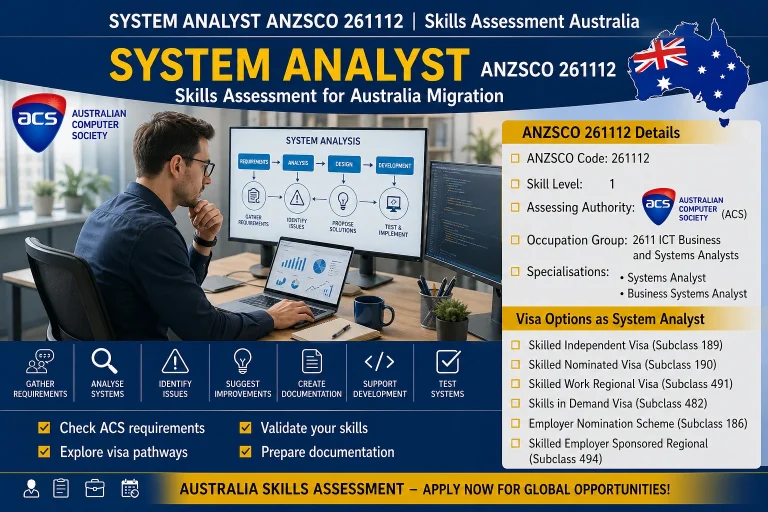
Here are the main tasks:
Task | What It Means |
Gather requirements | Talk to users and understand system needs |
Analyse systems | Research on existing systems |
Find issues | Identify problems or inefficiencies |
Suggest improvements | Recommend better systems |
Create documentation | Write system plans and reports |
Support development | Help developers build the system |
Test systems | Make sure everything works correctly |
System Analysts also guide decisions during projects and act as a link between teams.
This job falls within the Skill Level 1. This is the highest level in ANZSCO.
Category | Details |
Major Group | ICT Professionals |
Unit Group | 2611 ICT Business and Systems Analysts |
ANZSCO Code | 261112 |
Skill Level | 1 |
This implies that you normally require a degree or a higher education. Formal education may be substituted with a powerful work experience in certain situations
To become a System Analyst, you need both technical and soft skills.
You need to be in a position to present technical concepts in a straightforward manner.
Most applicants have:
Sometimes employers prefer higher education like a master’s degree, but it is not always required.
In the event that you lack an ICT degree, then you can also apply via work experience pathways.
To migrate to Australia, you need a positive skills assessment.
The Australian Computer Society (ACS) is an authoritative body for assessment.
They check:
Qualification | Work Experience Needed |
ICT Degree (related) | 2 years |
ICT Degree (not related) | 4 to 6 years |
Non-ICT Degree | Around 6 years + RPL |
No Degree | Around 8 years + RPL |
These requirements depend on your profile and experience.
System Analysts work in many industries:
They usually work in teams and may also work remotely.
Experience and location are the major factors influencing wages.
Experience Level | Average Salary (AUD/year) |
Entry Level | 70,000 to 85,000 |
Mid Level | 85,000 to 110,000 |
Experienced | 110,000 to 130,000+ |
You are able to transfer to senior positions or management with a greater experience.
System Analyst is listed on the Medium and Long Term Strategic Skills List.
This gives access to different visa options:
This renders it as an effective migration choice.
Here are some simple reasons:
This is the job to have in case you like to solve problems and to work with systems.
Pursuing a career as a System Analyst comes with its share of challenges, from understanding complex systems to managing tight deadlines and collaborating with diverse teams. Staying updated with evolving technology is also essential in this field.
However, these challenges become easier to handle with practical experience and continuous learning. Starting with a solid educational background in IT, developing technical and analytical skills, gaining hands-on experience, and improving communication abilities will set a strong foundation. Following these steps and completing the required skills assessment can help you move forward confidently in your professional and migration journey.
Email: info@australiaskillsassessment.com
Call/WhatsApp: +61 485 051 077
Website: australiaskillsassessment.com

Contact Us
Our Services
100% Secure
SSL Encrypted
4.9/5 Rated
We accept:
VISA
Mastercard
Stripe
Wise
PayPal
Disclaimer:
Copyright © 2020 – 2026 AustraliaSkillsAssessment
100% Secure Payments | Trusted in 70+ Countries | 4.9/5 Rated | 99% Success


