
Aeronautical Engineers design, develop, and maintain aircraft systems to ensure safe and efficient flight operations. They focus on performance, safety, and innovation in aviation technology.
Home > Aeronautical Engineer ANZSCO 233911
Flight Testing
Aircraft Design
Safety Systems
Maintenance Support
It is the position of an Aeronautical Engineer (ANZSCO 233911) to design, manufacture, test, and maintain aircraft systems to make sure they are safe and perform well. This employment involves working on the avionics, propulsion systems, aerodynamics, and the structures of planes. Engineers in this field also supervise the production process and test how well an airplane functions in different conditions. You might need to register or receive a license, depending on where you work and where you live.
If you’re interested in similar occupations, explore Telecommunications Field Engineer ANZSCO 313212 and Mechanical Engineer ANZSCO 233512 for in-depth insights on job roles, required qualifications, and Australian migration pathways.
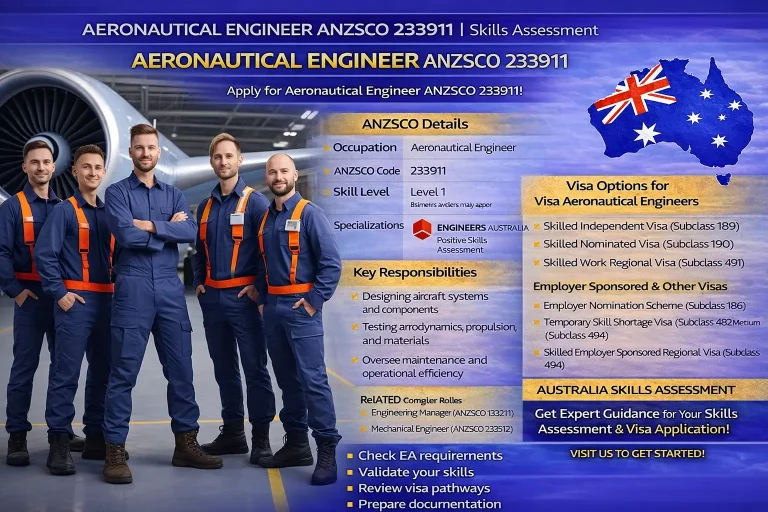
Aeronautical Engineers are involved in:
Category | Details |
Assessing Authority | Engineers Australia (EA) |
Requirement | Positive Skills Assessment |
Pathways Available | Accredited Qualification / CDR |
Pathway Type | Details / Requirements |
Accredited Qualification Pathway | Australian Qualification |
Washington Accord | |
Sydney Accord | |
Dublin Accord | |
CDR Pathway | For non-accredited qualifications |
Career Episodes | Three detailed engineering projects |
Summary Statement | Competency mapping report |
CPD | Continuing Professional Development |
CV/Resume | Updated professional resume |
This occupation is listed on the Medium and Long-term Strategic Skills List (MLTSSL), making it eligible for multiple visa pathways:
Applicants must meet one of the following:
Test | Minimum Requirement |
IELTS | 6 overall (7 speaking) |
OET | Grade B |
PTE | 65 overall |
TOEFL iBT | 93 overall |
To apply for skilled migration visas, candidates must:
This unit group includes engineering occupations not classified elsewhere, such as:
To become an Aeronautical Engineer, you typically need:
Australia Skills Assessment, we do everything we can to aid Aeronautical Engineers who desire to come to Australia. We write professional CDRs, help with Engineers Australia examinations, and prepare all the documents to make sure everything is proper and meets the standards. We also help with visas and moving from start to finish, so you can be sure you know what to do at every step.
If you have the right plan and seek support from a professional, you can make the whole process go more smoothly and quickly, and you will have a better chance of passing the skills test and securing your visa.
Explore related roles like Telecommunication Engineer ANZSCO 263311 and Production Engineer ANZSCO 233513 for better career opportunities in Australia
We’re here to assist with all your assessment needs.
Email: info@australiaskillsassessment.com
Email: zoya@australiaskillsassessment.com
Website: australiaskillsassessment.com

Contact Us
Our Services
100% Secure
SSL Encrypted
4.9/5 Rated
We accept:
VISA
Mastercard
Stripe
Wise
PayPal
Disclaimer:
Copyright © 2020 – 2026 AustraliaSkillsAssessment
100% Secure Payments | Trusted in 70+ Countries | 4.9/5 Rated | 99% Success


