
The Database Administrator is a good career opportunity that you can consider in case you think of immigrating to Australia and pursue a career in the field of IT. It comes under ANZSCO code 262111 and is part of the skilled occupation system.
Home > Database Administrator ANZSCO 262111
Data Security
DB Management
Performance Tuning
Backup Recovery
A Database Administrator manages and maintains an organisation’s database systems. They ensure data is kept in secure locations and easily accessed whenever it is necessary.
In simple words, they take care of all the data in a system. This is a position that deals with data. Every company stores data, so this role is very important. All is explained in a simple and clear manner in this guide.
They also safeguard information, enhance performance and ensure that systems perform without issues.
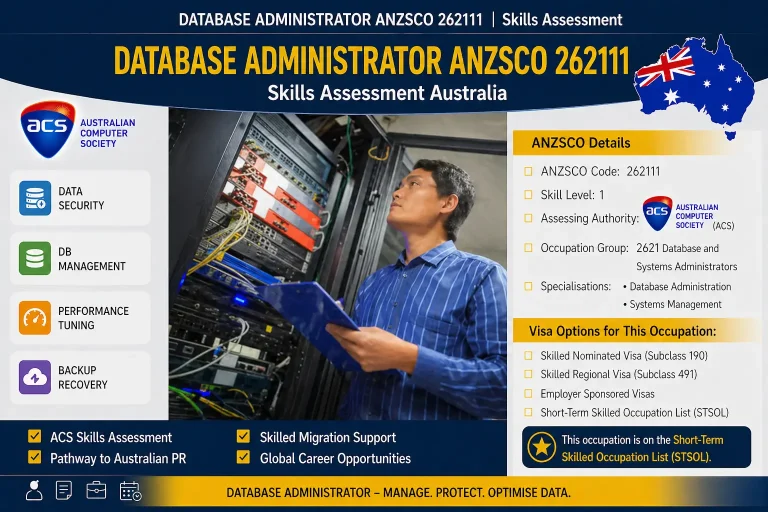
Here are the main tasks:
Task | What It Means |
Design databases | Create structure for storing data |
Maintain systems | Keep databases running smoothly |
Manage backups | Save data to prevent loss |
Ensure security | Protect data from risks |
Fix issues | Solve system problems |
Test systems | Checks and updates |
They also develop policies and procedures to handle data in an appropriate manner.
This occupation is classified as Skill Level 1 in ANZSCO.
Category | Details |
Major Group | ICT Professionals |
Unit Group | 2621 Database and Systems Administrators |
ANZSCO Code | 262111 |
Skill Level | 1 |
This implies that the majority require a bachelor degree or more.
To become a Database Administrator, you need both technical and soft skills.
You should be attentive since a minute error could have an impact on huge volumes of data.
Most applicants have:
If your degree is not related, you can still apply with enough work experience.
To migrate to Australia, you must complete a skills assessment.
The Australian Computer Society (ACS) is an authoritative body for assessment.
They check:
Qualification | Work Experience Needed |
ICT Degree (related) | Around 2 years |
ICT Degree (not related) | Around 4 to 6 years |
Non-ICT Degree | Around 6 years + RPL |
No Degree | Around 8 years + RPL |
These are requirements that are profile based.
Database Administrators work in many industries:
There are most working full-time and working on critical systems.
Pay is based on experience and expertise.
Experience Level | Average Salary (AUD/year) |
Entry Level | 75,000 to 90,000 |
Mid Level | 90,000 to 120,000 |
Experienced | 120,000 to 150,000+ |
The average salaries of this position range at AUD 100,000 and above annually.
Database Administrators are in steady demand because every company uses data.
Some key points:
The demand is expected to grow with cloud systems and data usage.
This occupation is available under different visa pathways.
Common options include:
Employer sponsorship or state nomination is often necessary in numerous cases.
Here are some simple reasons:
This role is good if you enjoy working with data and systems.
Some common challenges include:
Responsibility is high because Data is critical.
Follow these steps:
Email: info@australiaskillsassessment.com
Call/WhatsApp: +61 485 051 077
Website: australiaskillsassessment.com

Contact Us
Our Services
100% Secure
SSL Encrypted
4.9/5 Rated
We accept:
VISA
Mastercard
Stripe
Wise
PayPal
Disclaimer:
Copyright © 2020 – 2026 AustraliaSkillsAssessment
100% Secure Payments | Trusted in 70+ Countries | 4.9/5 Rated | 99% Success


