
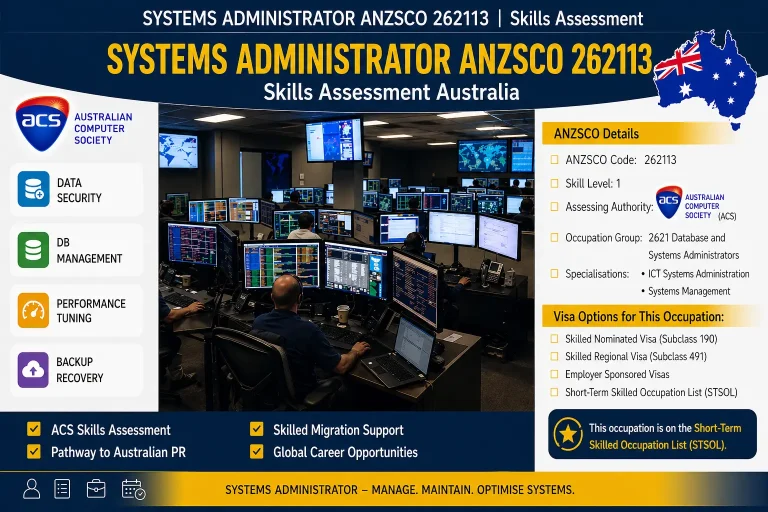
Systems Administrator is an excellent and realistic career to pursue in Australia as long as you are planning to relocate with an IT career. It comes under ANZSCO code 262113 and is part of the skilled occupation system.
Home > Systems Administrator ANZSCO 262113
Test Planning
Bug Reporting
Quality Assurance
System Validation
A Systems Administrator is the one who supports the computer systems, servers and networks within an organisation.
In simple words, they keep the system running without problems.
They are installers, troubleshooters, and ensure that everything is in place and performing correctly.
Here are the main tasks:
Task | What It Means |
Install systems | Set up servers and software |
Monitor performance | Check if systems are working well |
Fix issues | Solve hardware or software problems |
Manage backups | Protect data from loss |
Maintain security | Keep systems safe |
Update systems | Improve performance and reliability |
They also plan future system needs and suggest improvements for better performance.
Are you from the background of ICT Security Specialist ANZSCO 262112 ?
This occupation is classified at Skill Level 1 in ANZSCO.
Category | Details |
Major Group | ICT Professionals |
Unit Group | 2621 |
ANZSCO Code | 262113 |
Skill Level | 1 |
This implies that a majority of the population requires a bachelors degree or greater qualification.
To become a Systems Administrator, you need both technical and soft skills.
When systems fail, you must take some action quickly as businesses rely on it.
Most applicants have:
If your degree is not related, you can still apply with enough work experience.
In other instances, formal education may be substituted by experience or certifications that are strong.
To migrate to Australia, you must complete a skills assessment.
The Australian Computer Society (ACS) is an authoritative body for assessment.
They check:
Qualification | Work Experience Needed |
ICT Degree (related) | Around 2 years |
ICT Degree (not related) | Around 4 years |
Non-ICT Degree | Around 6 years + RPL |
No Degree | Around 8 years + RPL |
For example, if you have a relevant ICT degree, you usually need at least 2 years of experience.
Systems Administrators work in many industries:
Most work full-time, and around 90% are in full-time roles.
Systems Administrators are part of a larger ICT group with good earnings.
Some key points:
Salary can vary based on experience:
Experience Level | Average Salary (AUD/year) |
Entry Level | 70,000 to 85,000 |
Mid Level | 85,000 to 110,000 |
Experienced | 110,000 to 130,000+ |
Demand is steady because all companies depend on IT systems.
Systems Administrator is listed on skilled occupation lists, which allows different visa options.
Common pathways include:
A positive ACS skills assessment is required before applying.
Here are some simple reasons:
The job is fine when you like working on technical issues.
Some common challenges include:
You must keep up with the times, as technology evolves quickly.
Follow these steps:
Email: info@australiaskillsassessment.com
Call/WhatsApp: +61 485 051 077
Website: australiaskillsassessment.com

Contact Us
Our Services
100% Secure
SSL Encrypted
4.9/5 Rated
We accept:
VISA
Mastercard
Stripe
Wise
PayPal
Disclaimer:
Copyright © 2020 – 2026 AustraliaSkillsAssessment
100% Secure Payments | Trusted in 70+ Countries | 4.9/5 Rated | 99% Success


