
If you are planning to move to Australia with an IT career, the ICT Quality Assurance Engineer role is a very good option. It comes under ANZSCO code 263211 and is part of the skilled occupation system.
Home > ICT Quality Assurance Engineer ANZSCO 263211
Test Planning
Quality Checks
Bug Tracking
System Validation
An ICT Quality Assurance Engineer checks and improves the quality of computer systems and software.
Put simply, they ensure it works well and is in compliance.
They review systems, test processes, and ensure processes comply with rules and guidelines.
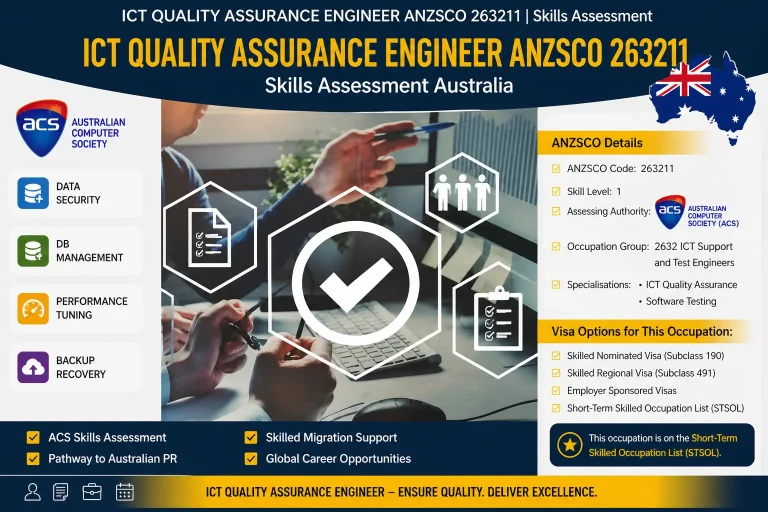
Here are the main tasks:
Task | What It Means |
Conduct audits | Check systems and processes |
Review systems | Analyse performance and data |
Identify risks | Find possible issues or failures |
Suggest improvements | Fix problems and improve quality |
Ensure standards | Follow rules and guidelines |
Communicate issues | Report findings to teams |
They also test systems and check documents, and provide advice for teams.
This occupation is classified at Skill Level 1 in ANZSCO.
Category | Details |
Major Group | ICT Professionals |
Unit Group | 2632 ICT Support and Test Engineers |
ANZSCO Code | 263211 |
Skill Level | 1 |
So, most people have a bachelor degree or above.
To become an ICT Quality Assurance Engineer, you need both technical and soft skills.
You have to spot small mistakes – they can have a big impact on the system.
Most applicants have:
Experience and qualifications can sometimes be substituted for education.
To migrate to Australia, you must complete a skills assessment.
The Australian Computer Society (ACS) is an authoritative body for assessment.
They check:
Qualification | Work Experience Needed |
ICT Degree (related) | Around 2 years |
ICT Degree (not related) | Around 4 to 6 years |
Non-ICT Degree | Around 6 years + RPL |
No Degree | Around 8 years + RPL |
If you do not have a degree, you may need to apply through Recognition of Prior Learning (RPL).
ICT Quality Assurance Engineers work in many industries:
About 87% of workers are full-time, and they usually work around 41 hours per week.
This role is in high demand as businesses need quality software.
Some key points:
Pay is based on skills and experience.
Experience Level | Average Salary (AUD/year) |
Entry Level | 75,000 to 90,000 |
Mid Level | 90,000 to 115,000 |
Experienced | 115,000 to 135,000+ |
Automation and advanced testing skills can increase your salary.
ICT Quality Assurance Engineer is listed on skilled occupation lists.
Common visa options include:
Often state sponsorship or company sponsorship is needed.
Here are some simple reasons:
This is a great career if you like to test systems and find errors.
Some common challenges include:
Patience and focus are essential for quality work.
Follow these steps:
Email: info@australiaskillsassessment.com
Call/WhatsApp: +61 485 051 077
Website: australiaskillsassessment.com

Contact Us
Our Services
100% Secure
SSL Encrypted
4.9/5 Rated
We accept:
VISA
Mastercard
Stripe
Wise
PayPal
Disclaimer:
Copyright © 2020 – 2026 AustraliaSkillsAssessment
100% Secure Payments | Trusted in 70+ Countries | 4.9/5 Rated | 99% Success


