
If you are planning to move to Australia with an IT career, Web Administrator is one of the practical options. It comes under ANZSCO code 313113 and belongs to the ICT support technician group.
Home > Web Administrator ANZSCO 313113
Server Management
Website Maintenance
Security Updates
Performance Monitoring
A Web Administrator is responsible for managing websites and web systems in an organisation.
Put simply, they maintain websites, keep them up-to-date and secure.
They also manage website speed, troubleshoot and support company web tools.
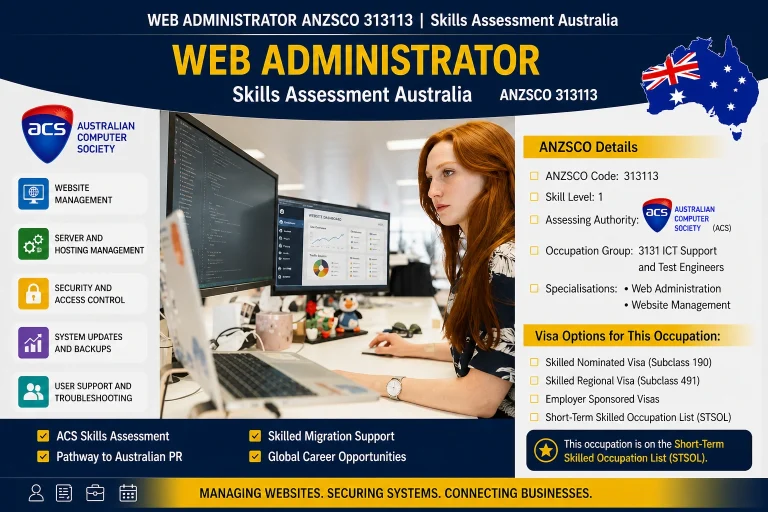
Here are the main tasks:
Task | What It Means |
Build websites | Create and maintain web pages |
Manage CMS | Manage systems such as WordPress or other systems |
Monitor performance | Check website speed and traffic |
Fix issues | Solve website errors and bugs |
Update content | Keep website information current |
Improve security | Protect websites from attacks |
They also update, backup and help web users.
This occupation is classified at Skill Level 2 in ANZSCO.
Category | Details |
Major Group | ICT Support Technicians |
Unit Group | 3131 Web Administrators |
ANZSCO Code | 313113 |
Skill Level | 2 |
For a Skill Level 2 job, you usually need an associate degree or diploma, or lots of experience.
To become a Web Administrator, you need both technical and practical skills.
This role is more hands-on than theoretical.
Most applicants have:
You can sometimes substitute experience if you don’t have education.
3 years of experience or a vendor’s certification is required.
To migrate to Australia, you must get a positive skills assessment from ACS (Australian Computer Society).
They check:
Qualification | Work Experience Needed |
ICT Degree (closely related) | 2 years |
ICT Degree (not closely related) | 4 years |
Diploma / ICT Minor | 5 to 6 years |
No Degree | 8 years + RPL |
RPL (Recognition of Prior Learning) is needed if you do not have formal ICT education.
Web Administrators work in many industries:
Most are full-time and many are remote work.
This job is small but stable in Australia.
Some key data:
Estimated salary range:
Experience Level | Average Salary (AUD/year) |
Entry Level | 60,000 to 75,000 |
Mid Level | 75,000 to 95,000 |
Experienced | 95,000 to 110,000+ |
Pay varies by website skills, tools and company size.
Web Administrator is often listed on skilled occupation lists like STSOL.
This means:
But PR pathways can depend on state nomination and job demand.
Here are some simple reasons:
It’s a great job if you enjoy web design.
Some common challenges include:
The web is ever evolving, so you need to keep learning.
Follow these steps:
Email: info@australiaskillsassessment.com
Call/WhatsApp: +61 485 051 077
Website: australiaskillsassessment.com

Contact Us
Our Services
100% Secure
SSL Encrypted
4.9/5 Rated
We accept:
VISA
Mastercard
Stripe
Wise
PayPal
Disclaimer:
Copyright © 2020 – 2026 AustraliaSkillsAssessment
100% Secure Payments | Trusted in 70+ Countries | 4.9/5 Rated | 99% Success


