
EA migration skills assessment documents, CDR pathway checklist Australia, Engineers Australia CDR requirements, Australia skills assessment for engineers, EA English language requirements
Home > Engineers Australia Skill Assessment Document Checklist
Confirm Your Pathway
Documents By Category
Avoid Common Rejections
Fees & Timelines
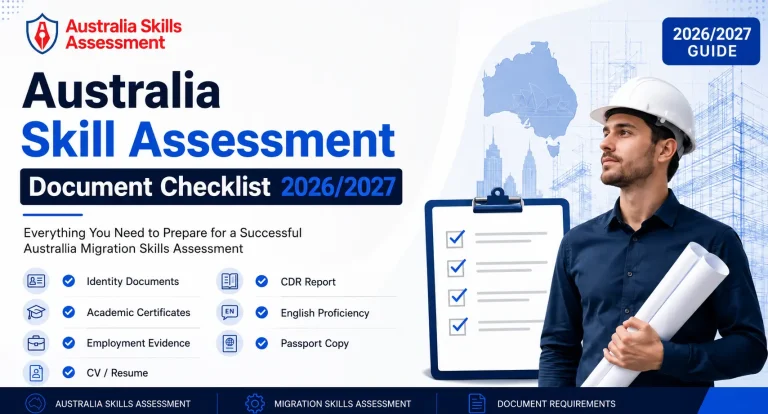
The first real challenge in the skilled visa process for engineers is the Engineers Australia Skill Assessment Document Checklist. Not the career episodes, nor the fees, but the paperwork. Engineers Australia cannot begin to evaluate your application until every required document is uploaded correctly and if a document is not uploaded or it is blurry, your timeline will be extended by weeks.
This guide does not list the checklist by pathway only, as you can see all the documents required both in the pathway and through the Competency Demonstration Report (CDR ) route.
Before you start collecting documents, work out which pathway you’re on. It changes what you need to prepare.
If your degree is accredited under the Washington Accord, Sydney Accord, Dublin Accord, or is an Australian qualification which EA has accredited directly, you are following the accredited pathway.
You’re on the CDR pathway if your qualification isn’t accredited, if you want to be assessed under a different occupation than your degree title suggests, or if you’re applying as an Engineering Manager.
Not sure which one applies to you? It’s important to verify before you gather a single document, because it changes your entire checklist. You can look through pathways and document details for your specific occupation on our CDR for Australia page.
This is a general idea of the order to avoid the most frequent delays:
Document Category | Accredited Pathway | CDR Pathway |
Passport bio-data page (colour scan) | Required | Required |
Recent passport-sized photo | Required | Required |
Name change document (if applicable) | Required | Required |
Updated CV or resume | Required | Required |
Degree certificate (testamur) | Required | Required |
Academic transcripts (with certified translation if not in English) | Required | Required |
English test result (or exemption evidence) | Required | Required |
CPD (Continuing Professional Development) record | Not required | Required |
Three Career Episodes (1,000-2,500 words each) | Not required | Required |
Summary Statement | Not required | Required |
Employment reference letters | Only for a separate Relevant Skilled Employment assessment | Required if claiming work experience |
The general formatting guidelines include all documents to be a colour scan of the original and uploaded as a PDF file under 5MB. If your originals are not written in English, upload both the original and a certified translation of the original and include the registration ID and contact information of the translator on the translated copy, not as an attached note.
Most delays happen not because of a problem with the paperwork. They’re about formatting mistakes that could’ve been avoided:
EA accepts IELTS (General or Academic), TOEFL iBT, and PTE Academic. Minimum requirement is module, NOT average. Often a good overall score and a weak section are not sufficient.
Test | Minimum Score (per module) |
IELTS | 6.0 |
TOEFL iBT | Listening 12, Reading 13, Writing 21, Speaking 18 |
PTE Academic | 50 |
Your result has to be dated within three years of your submission.
You might not need a test at all if you’ve completed at least two academic years (a minimum of 92 weeks) at a CRICOS-registered Australian institution, or if you hold citizenship and a valid passport from the UK, USA, Canada, New Zealand, or Ireland. In either case you will still have to have documentation of the exemption, and EA may request a test result if they wish to have additional evidence of your English skills.
Three documents are more important than any others for those on the CDR pathway and most rejections occur in these documents.
Career Episodes: are three written accounts, each between 1,000 and 2,500 words, describing real engineering work you’ve done. Academic projects are also included if you are a recent graduate and have little industry experience. In each episode introduce the project title, dates, location and organisation and then discuss the steps you took to solve the problem: problem definition, planning a solution, delivering the solution and evaluating the outcome. Later, when you’re cross referencing your Summary Statement, it will be easier if you numbered the paragraphs.
The Summary Statement: is a table that correlates each of the required competencies for your occupational category to the specific paragraph of your Career Episodes that you demonstrated the competency. All competencies must be demonstrated at least once throughout each of the three episodes. Before the action of writing, do some research to find out which occupational category or code that best fits your role, if you’re not sure, as this will determine which competencies you need to include.
The CPD list: is simply a written record of the training, courses, and professional development you’ve done.
There are few patterns come up again and again:
What Happens After You Submit engineers australia skill assessment document checklist
These figures are pulled directly from EA’s official fee schedule, current as of July 2026.
Assessment Type | Fee excl. GST (AUD) | Fee incl. GST (AUD) |
Washington/Sydney/Dublin Accord qualification assessment | $505 | $555.50 |
Australian accredited qualification assessment | $315 | $346.50 |
Standard CDR assessment | $940 | $1,034 |
Fast-track add-on (any pathway) | $360 | $396 |
Here are a couple of points to be aware of about fast-track: it will ensure that your application is assigned to an assessor within 20 business days, but it will not mean that you will receive a result within that time. It also doesn’t forgo the document review phase, and so a shoddy application will make for a slow process regardless of paid for.
These fees are reviewed annually by EA and it is recommended that you always check the most up-to-date fees on Engineers Australia’s official fee page before budgeting. Our pricing page shows what is covered in each tier if you prefer to receive advisory support as well as assistance making costs calculations.
What documents do I need for an Engineers Australia skill assessment?
At a minimum: passport, photo, CV, degree certificate, academic transcripts, and an English test result or exemption evidence. If you’re on the CDR pathway, add three Career Episodes, a Summary Statement, and a CPD list.
Do I need work experience for an Engineers Australia assessment?
Not always. The core assessment is about your qualification. Work experience only comes into play if you’re applying for a separate Relevant Skilled Employment assessment, or if you’re using work projects (instead of academic ones) as the basis for your CDR Career Episodes.
Can someone else write my Career Episodes for me?
No. EA requires these to be your own original work. Having a third party write them and submitting them as your own counts as plagiarism, and the penalties include rejection plus a multi-year ban on reapplying.
How long is an Engineers Australia skill assessment document checklist valid?
Generally around three years from the date of a positive outcome, though it’s worth checking the current EA guidelines for your specific visa.
What’s the difference between the accredited pathway and the CDR pathway?
The accredited pathway covers degrees recognised under specific international accords, or Australian-accredited degrees, and it’s mostly paperwork. The CDR pathway is for non-accredited qualifications and requires you to demonstrate your competency through written Career Episodes and a Summary Statement, on top of the standard documents.
What happens if my application is incomplete?
EA pauses it at the completeness check rather than rejecting it outright, but the processing clock stops until you supply what’s missing. It’s genuinely faster to submit a complete application the first time than to fix one mid-review.
Can I apply if I graduated outside an Accord country?
Yes. That’s exactly what the CDR pathway is for. Wherever you studied, if your qualification isn’t accredited, you go through CDR and demonstrate your competency directly.
Do I need a separate assessment just for work experience?
Only if you want your employment formally assessed and endorsed as its own Relevant Skilled Employment assessment. For most CDR applicants, work experience is folded into the Career Episodes instead of assessed on its own.
Need help working out which pathway fits your qualification, or want someone to check your documents before you submit? Australia Skills Assessment Advisor works with engineers preparing for EA, ACS, and VETASSESS assessments. Have a look at our service offerings, read more about us, or get in touch if you’d like your Engineers Australia skill assessment document checklist reviewed before submission
Email: info@australiaskillsassessment.com
Call/WhatsApp: +61 485 051 077
Website: australiaskillsassessment.com

Contact Us
Our Services
100% Secure
SSL Encrypted
4.9/5 Rated
We accept:
VISA
Mastercard
Stripe
Wise
PayPal
Disclaimer:
Copyright © 2020 – 2026 AustraliaSkillsAssessment
100% Secure Payments | Trusted in 70+ Countries | 4.9/5 Rated | 99% Success


